AI Visibility Audit: What It Tells You About Your Brand
Your customers are asking AI assistants what to buy. Some of those assistants live inside retailer sites, one click from the Add to Cart button. Most brands have no read on how they show up there. You can get a first read in an afternoon.
I ran this exercise for a leading bathroom fixtures brand using a few buyer questions, asked over and over across the AI tools consumers use for product research, capturing every answer. Here's what this quick AI visibility audit tells you, and how far you can trust each read.
The setup
One category: bathroom fixtures.
The top 3 buyer questions people type in the middle of the funnel (MOTF), when they're comparing options but haven't landed on a brand.
Twenty runs of each question. This isn't a quantitative research study, but rather a manual audit to show what this method surfaces.
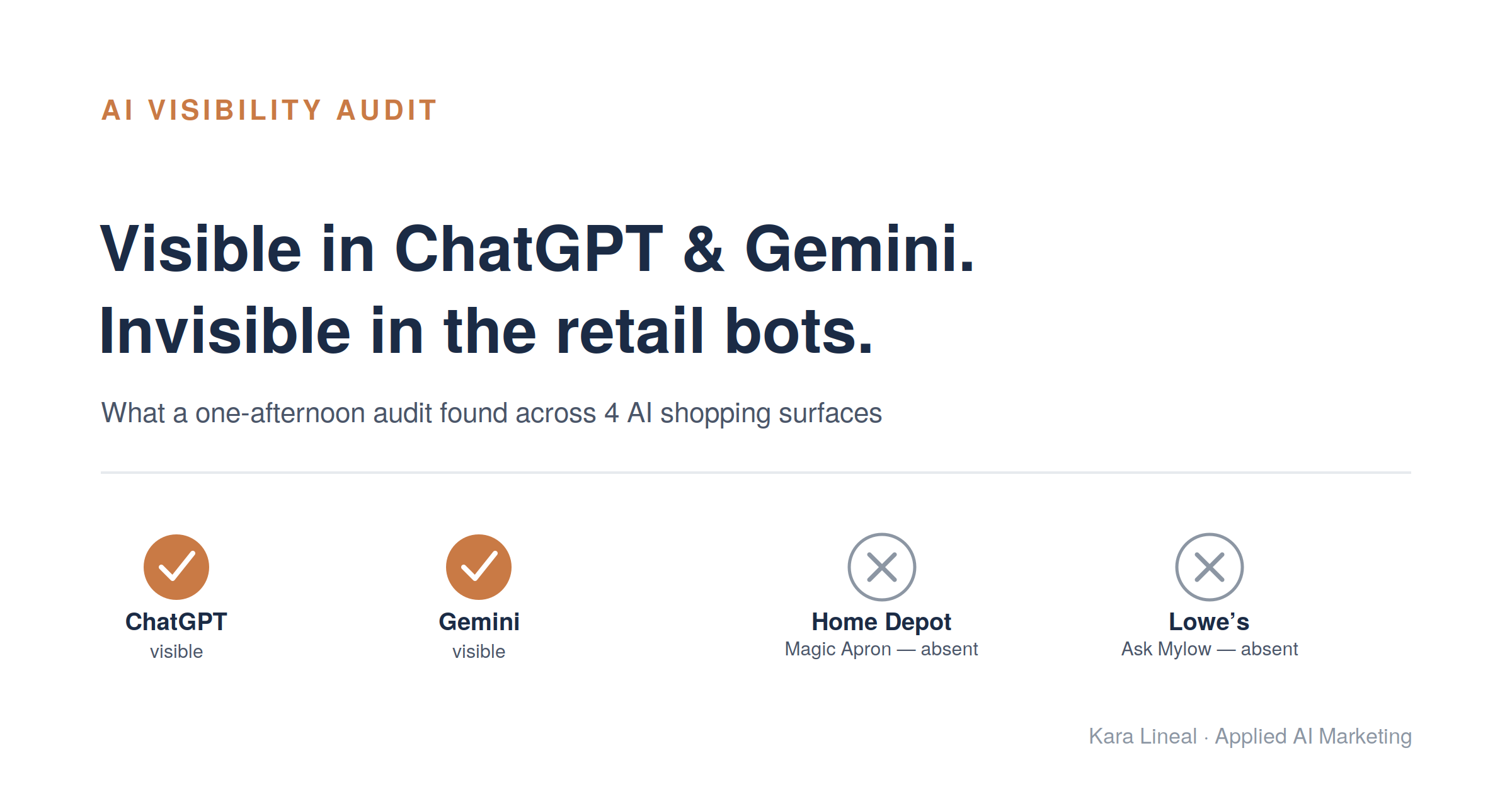
Four surfaces: the two general assistants preferred by consumers as of September 2026 (ChatGPT and Gemini) and two shopping bots (Home Depot's Magic Apron and Lowe's Ask Mylow) consumers commonly use to shop for bathroom fixtures in the USA.
Method: I logged every answer in a spreadsheet, then used Claude to count brand mentions and label sentiment on each response (was the assistant talking a shopper into the brand, or out of it?).
1. Coverage
Where your brand shows up
Is your brand referenced in AI responses or not? In my sample, the brand appeared in nearly every general-assistant run and almost none of the retailer-bot runs.
Insight: The brand was missing from the surfaces sitting closest to checkout.
2. General assistants vs. retailer bots
Two different results
General AI assistants and retailer AI bots behave differently. General assistants like ChatGPT and Gemini generate answers from broad training and web content. Retailer bots generate answers from the retailer's own catalog, ratings, and merchandising logic. Retailer bots also sit much closer to the purchase.
Insight: A brand can win citations and references in general AI assistants and lose visibility in retailer AI bots.
3. Share of voice
Mentioned ≠ recommended
List every brand each AI answer names, then measure the number of mentions and recommendations. AI responses are distinctly different from search engine optimization (SEO), which is measured in keywords and clicks without sentiment, persuasion or context. My studied brand had the most mentions in one category and still lost as the recommended brand. A competitor held the explicit "my pick" slot in every run of one assistant, while the studied brand was the clear top choice in exactly one capture out of forty. Mention count flattered it. The recommendation slot told the truth.
Insight: A brand can win mentions but lose recommendations. A recent study by Semrush found that 57.5% of regular AI users have been talked out of buying a product by an AI chatbot.
4. Category effects
Don't average your product catalog
AI answers change by product line. The same brand, in the same tools on the same day, was reasonably visible for one product type and close to invisible for another. One line was a strength story; the other was a gap. Average them together and you'd have seen neither.
Insight: A brand’s AI visibility can vary dramatically by product category, so averaging across the catalog can hide both its strengths and its gaps.
5. Sentiment
Measure how you show up, not just whether
Showing up isn't the finish line. A brand named as the top pick is in a stronger position than a brand that is buried three deep in a list. In my sample, general-assistant mentions were almost all positive; the few retailer-bot mentions were flatter and more neutral.
Insight: A brand’s value in AI does not just depend on being mentioned, but on whether it is prominently and positively presented as the best choice.
6. Run-to-run variance
Ask the same question, get different answers
Ask the identical question five-plus times and you won't get five identical answers. Across five runs of one prompt, one retailer bot returned the brand as: invisible, invisible, top-recommended, prominent, invisible. Since AI visibility can change from one answer to the next, it is not something you set once and forget.
Insight: A brand’s AI visibility can change dramatically between identical queries, so measure repeated runs on a regular basis.
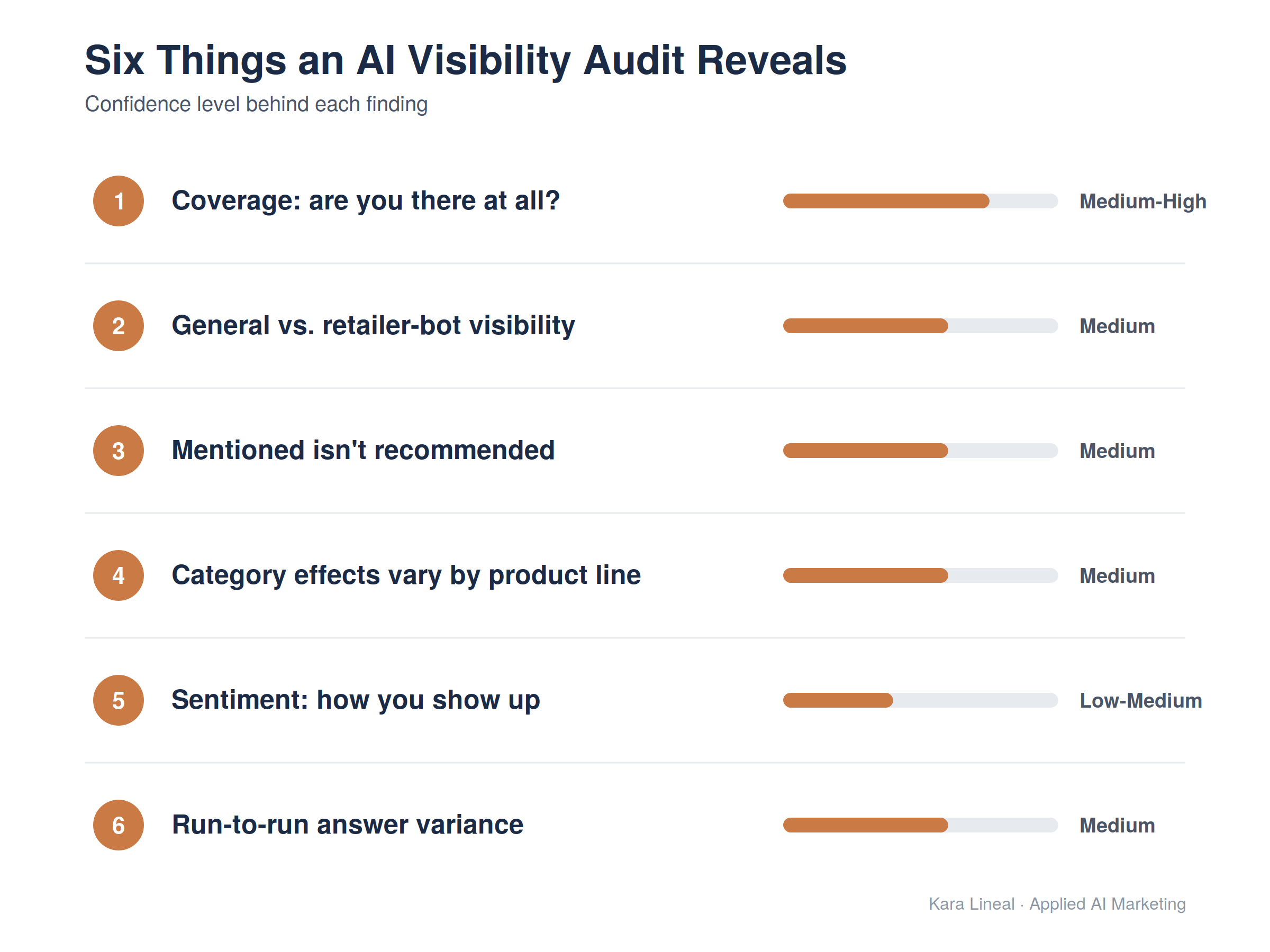
Confidence ratings are directional, not statistical, based on 40 captures across ChatGPT, Gemini, and two retailer bots in a single afternoon using the Claude Chrome browser extension and Google Sheets.
Check your AI brand visibility
Turn AI visibility into a quick performance check for your brand.
Start with the questions shoppers ask when researching the product categories that matter most to your business and profit margin. For example: “What is the best [product] for [need]?” or “Which [product] should I buy?”
Run those same questions on a schedule across the AI tools that influence shoppers, including:
General AI assistants, such as ChatGPT and Gemini
Retailer AI tools and shopping bots
Track two simple metrics over time:
Coverage rate: How often your brand appears in the answer
#1 recommendation rate: How often your brand is named as the top choice
If your brand is missing or losing on a retailer’s AI tool, compare your product listing with the listings that win. Look for practical differences such as:
Star ratings and review count
Product titles, descriptions, images, and specifications
Price and promotional position
Availability, shipping, and assortment
Clear reasons the winning product fits the shopper’s need
This turns an audit into action. The audit shows where you are losing the recommendation. The product listing comparison helps explain why—and what to improve.
That is what generative engine optimization (GEO) and answer engine optimization (AEO) look like in practice: identify the buyer questions, capture the AI answers, measure who gets the top recommendation, and close the gaps that keep your brand from winning.
AI-assisted research and drafting; independently reported, verified, and edited by the author.